Play Anything by Ian Bogost
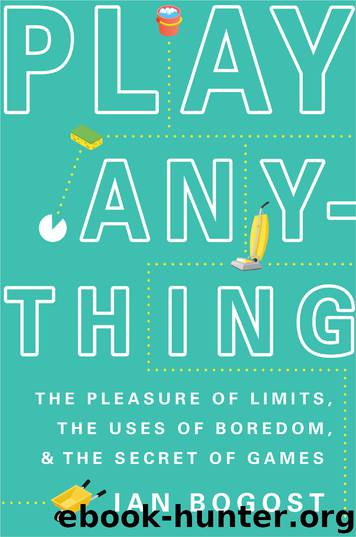
Author:Ian Bogost
Language: eng
Format: epub, mobi
ISBN: 9780465096503
Publisher: Basic Books
Published: 2016-08-15T16:00:00+00:00
SO URGENT HAS our mistrust of things become, we have begun to embrace restraint at any cost. Asceticism is in, and it’s glamorous. Marie Kondo, a Japanese organizing consultant, has sold millions of copies of her books on decluttering. Her “KonMari” method: by putting your belongings in order, by ridding yourself of unnecessary items, and by conducting a holistic bout of decluttering rather than a space-by-space or room-by-room one, you can achieve a lasting contentment.8 KonMari recommends the depopulation of your living space, and Kondo offers a singular criterion to determine if items ought to stay or go. The successful tidier, according to Kondo, is one who is “surrounded only by things they love.”
The process of removing things to create completeness has a history in Eastern culture. The principle of yohaku roughly corresponds with what we’d call “negative space” in the West. It finds its way into Chinese and Japanese art in the sparing application of ink or pigment on drawings and paintings, or the spartan design of Zen gardens. Western modernism holds similar values; for example, the maxim of “less is more” that Schwarz inverts in his subtitle comes from the mid-century architect and furniture designer Ludwig Mies van der Rohe. The French writer and aviator Antoine de Saint-Exupéry fashioned a less austere and more poetic version of the same idea: “perfection is finally attained not when there is no longer anything to add, but when there is no longer anything to take away.”9
Kondo’s workaday version of yohaku is more pragmatic and less pretentious: you start KonMari by discarding broken things, obsolete tools, and once useful objects whose utility has since passed due to changing circumstances. As for the rest, Kondo offers one sole heuristic for determining whether an item should stay or go. “Take each item in one’s hand,” she urges, “and ask, Does this spark joy? If it does, keep it. If not dispose of it.”10 Kondo admits that it’s a vague guideline, but she trusts your ability to make an affective diagnosis. “The trick is to handle each item. When you touch a piece of clothing, your body reacts.”11
Like Schwartz and Wampole, Kondo’s approach to regulated asceticism puts the burden of creating conditions of simplicity on the agent who would presumably benefit from its outcome. But for Kondo, this purge is a one-time process. After the hard work of an initial purge, the temptations of modest hoarding to which we are all susceptible can be overcome, because Kondo encourages tidiers to anthropomorphize their skirts and appliances and handbags and razors and all the rest. Her approach attributes a soul or a life to inanimate objects.
This commitment to animism (a tendency more common in the East) cuts both ways. On the one hand, it gives KonMari an easy model for practicing a respect for the objects with which its practitioners surround themselves: think of them like kittens or hedgehogs or other living creatures. Recounting a particularly egregious act of contempt against socks by a client, who had rolled them into balls for storage, Kondo exhorts, “Look at them carefully.
Download
This site does not store any files on its server. We only index and link to content provided by other sites. Please contact the content providers to delete copyright contents if any and email us, we'll remove relevant links or contents immediately.
| Anthropology | Archaeology |
| Philosophy | Politics & Government |
| Social Sciences | Sociology |
| Women's Studies |
Cecilia; Or, Memoirs of an Heiress — Volume 1 by Fanny Burney(32558)
The Great Music City by Andrea Baker(32018)
Cecilia; Or, Memoirs of an Heiress — Volume 2 by Fanny Burney(31956)
Cecilia; Or, Memoirs of an Heiress — Volume 3 by Fanny Burney(31941)
We're Going to Need More Wine by Gabrielle Union(19046)
All the Missing Girls by Megan Miranda(16026)
Pimp by Iceberg Slim(14506)
For the Love of Europe by Rick Steves(14121)
Bombshells: Glamour Girls of a Lifetime by Sullivan Steve(14073)
Talking to Strangers by Malcolm Gladwell(13370)
Norse Mythology by Gaiman Neil(13363)
Fifty Shades Freed by E L James(13239)
Mindhunter: Inside the FBI's Elite Serial Crime Unit by John E. Douglas & Mark Olshaker(9341)
Crazy Rich Asians by Kevin Kwan(9291)
The Lost Art of Listening by Michael P. Nichols(7506)
Enlightenment Now: The Case for Reason, Science, Humanism, and Progress by Steven Pinker(7313)
The Four Agreements by Don Miguel Ruiz(6765)
Bad Blood by John Carreyrou(6621)
Weapons of Math Destruction by Cathy O'Neil(6279)
